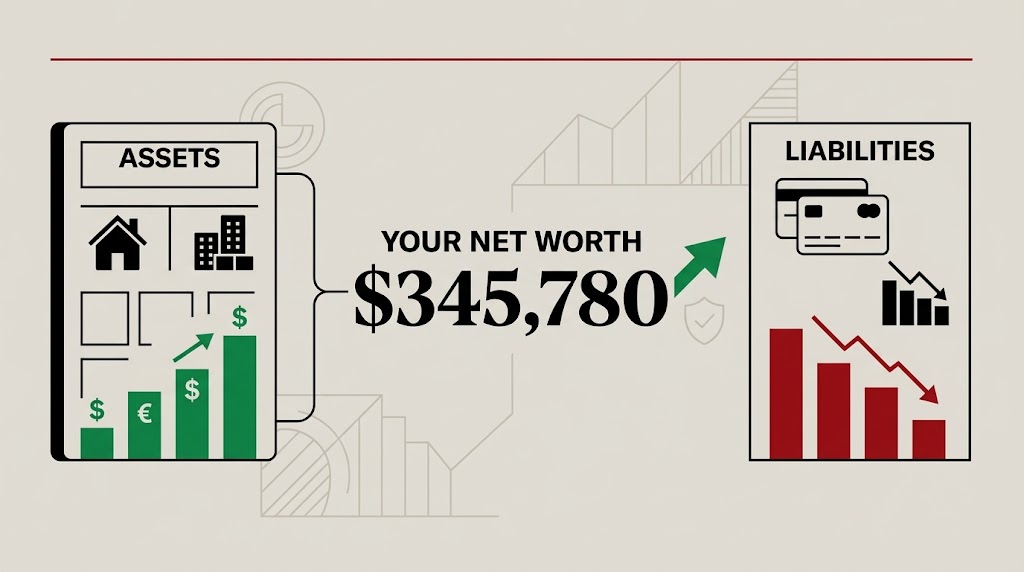
Understanding your financial standing is the foundation of long-term wealth building. Whether you are managing everyday expenses, paying down student loans, or building an expansive investment portfolio, tracking your net worth provides a clear, objective snapshot of your financial health.
Use our free, private Net Worth Calculator below to instantly compute your total assets and liabilities.
Net Worth Calculator
Add what you own and what you owe. Your result updates instantly.
Changing currency converts every value using a daily reference exchange rate. Rates By Exchange Rate API
What is Net Worth and How is it Calculated?
At its core, net worth is a simple mathematical equation representing your financial baseline. It is the exact difference between what you own and what you owe.
The Universal Net Worth Formula:
Net Worth = Total Assets – Total Liabilities
- Positive Net Worth: Your assets exceed your liabilities. This indicates a healthy financial baseline where you own more value than you owe to creditors.
- Negative Net Worth: Your liabilities exceed your assets. This is common for recent graduates with student loans or new homeowners, indicating that debt reduction should be a primary financial focus.
This straightforward metric is exactly how financial analysts evaluate corporate valuations, and it is the same baseline methodology we use when investigating the creator economy and influencer net worths across ICW.
How to Categorize Your Assets (What You Own)
To get an accurate assessment, you must tally everything of significant financial value that you own. Assets are generally broken down into three categories:
1. Liquid Assets
These are cash equivalents that can be accessed immediately without losing value.
- Checking and savings account balances.
- High-yield savings accounts (HYSA).
- Physical cash on hand.
2. Marketable Investments
These are financial instruments that can be sold for cash, though their value fluctuates with the market.
- Brokerage accounts, individual stocks, and mutual funds.
- Retirement funds (such as a 401(k), IRA, or Roth IRA).
- Government bonds and certificates of deposit (CDs).
- Cryptocurrency portfolios.
3. Tangible & Real Estate Assets
These are physical items of value. They are considered “illiquid” because they take time to sell.
- The current market value of your primary residence.
- Investment properties and commercial real estate.
- Vehicles (cars, boats, motorcycles) at their current resale value.
- Business equity (your ownership stake in a private company).
How to Categorize Your Liabilities (What You Owe)
Liabilities encompass all of your outstanding debts and financial obligations to outside institutions.
1. Secured Debt
Debt backed by a physical asset that the lender can repossess if you default.
- Mortgages: The remaining principal balance on your home.
- Auto Loans: The outstanding financing on your vehicles.
- HELOCs: Home equity lines of credit.
2. Unsecured Debt
Debt not tied to a specific asset, typically carrying much higher interest rates.
- Credit Cards: The total revolving balance across all your cards.
- Personal Loans: Unsecured lines of credit from banks or private lenders.
- Student Loans: Outstanding educational debt.
- Medical Debt & Taxes: Unpaid medical bills or outstanding tax liabilities.
3 Reasons You Must Track Your Net Worth
If you regularly read our financial breakdowns on the wealth of creators like Bella Poarch or Tara Mongeau, you know that top-line income is only half the story. Earning a high salary does not automatically equal wealth if that income is immediately consumed by high-interest debt or lifestyle inflation.
- It Measures True Financial Progress: Income tells you what you earn; net worth tells you what you keep. Tracking it monthly or quarterly reveals if your wealth is actually growing.
- It Highlights Debt-to-Asset Ratios: It forces you to confront your liabilities, helping you prioritize paying down toxic, high-interest debt over acquiring more depreciating assets.
- It Establishes a Retirement Baseline: You cannot plan for financial independence without knowing your starting point.
Frequently Asked Questions (FAQ)
Is my financial data safe in this calculator?
Yes. This calculator runs entirely in your local browser using client-side JavaScript. Your financial figures are never transmitted to our servers, saved to a database, or shared with third parties.
How often should I check my net worth?
For most individuals, calculating net worth quarterly (every three months) or semi-annually is sufficient. Checking too frequently can cause unnecessary stress due to normal, short-term market fluctuations in stock or real estate values.
What is a “good” net worth?
A “good” net worth is highly subjective and depends entirely on your age, location, and lifestyle goals. The calculator includes a benchmark tool that uses U.S. demographic data, allowing you to compare your financial standing to the median for your age group.